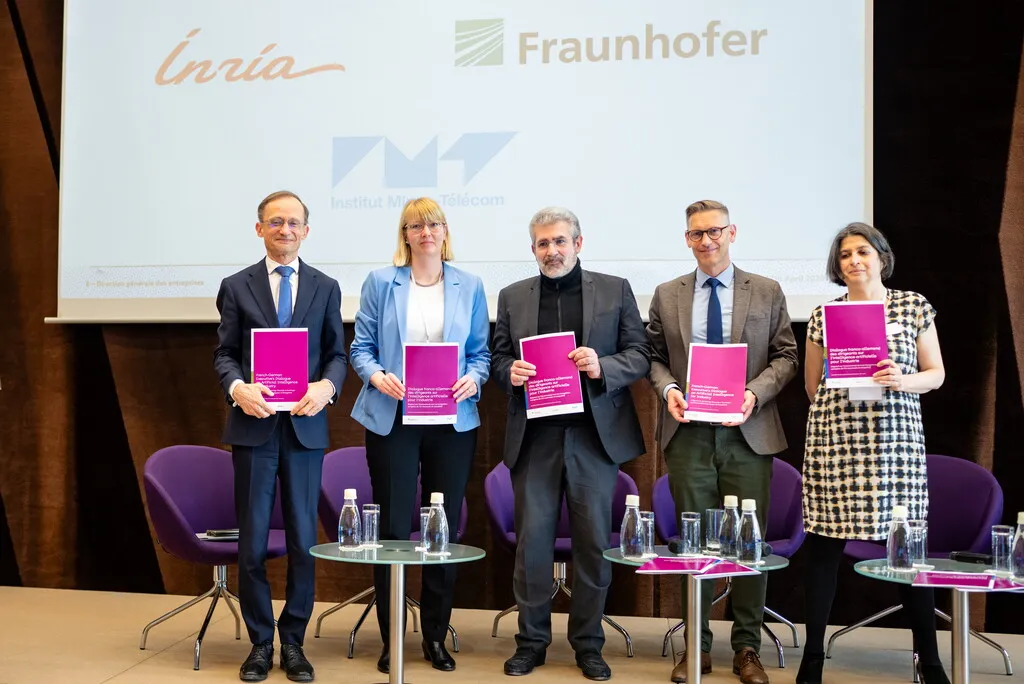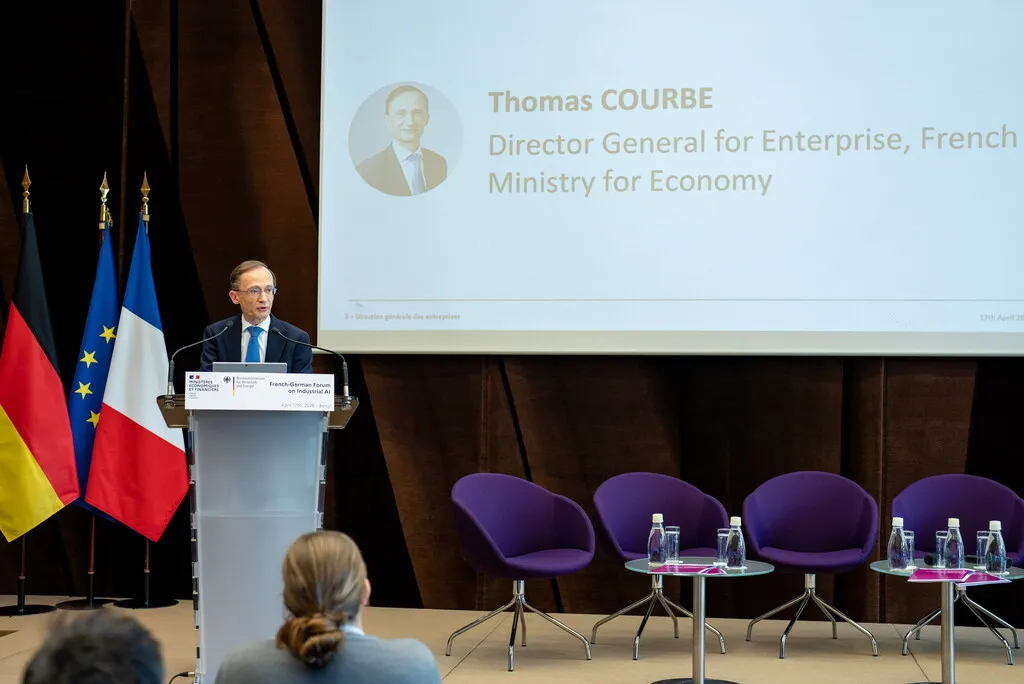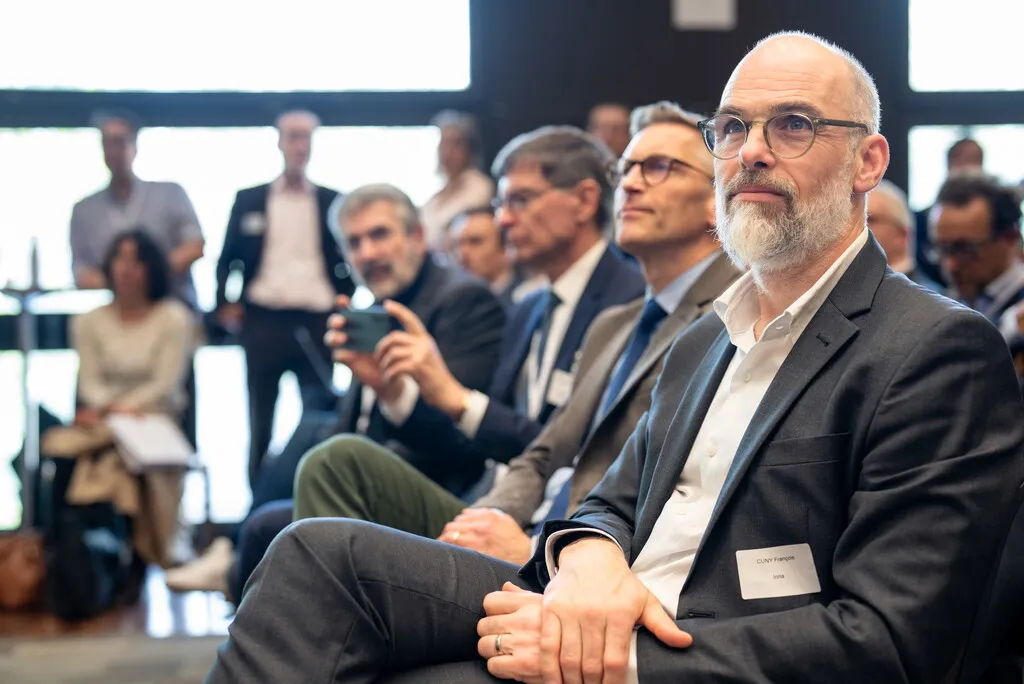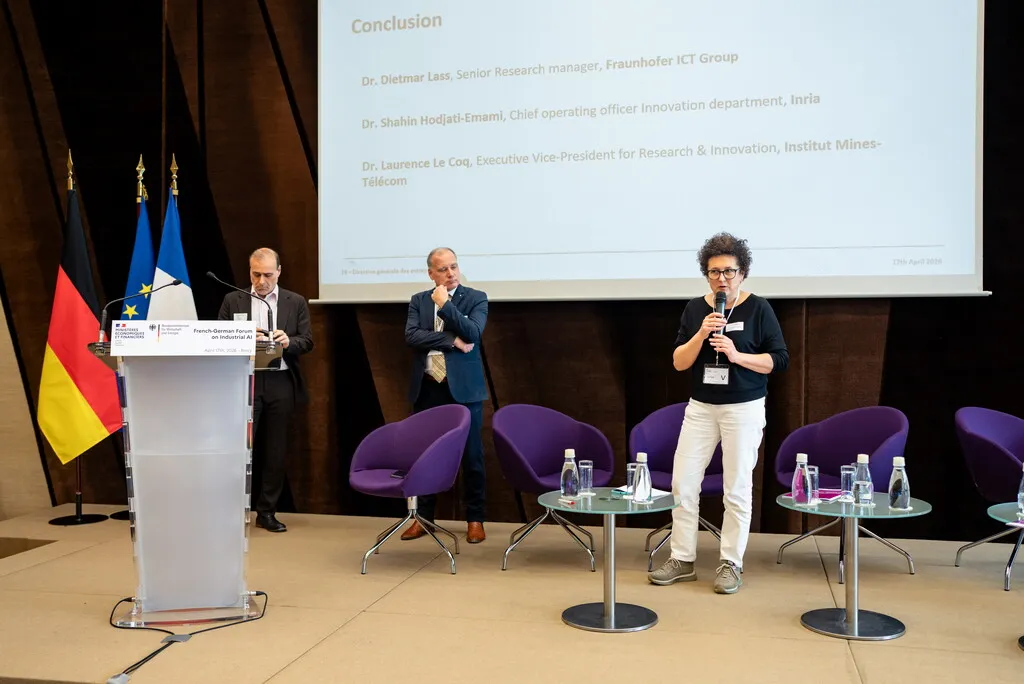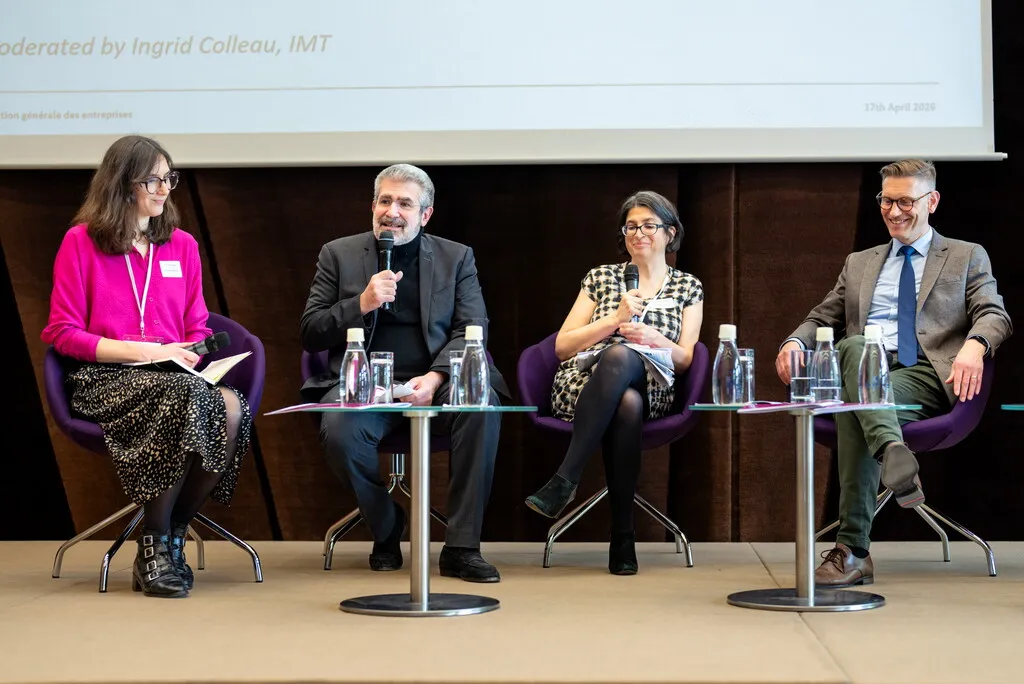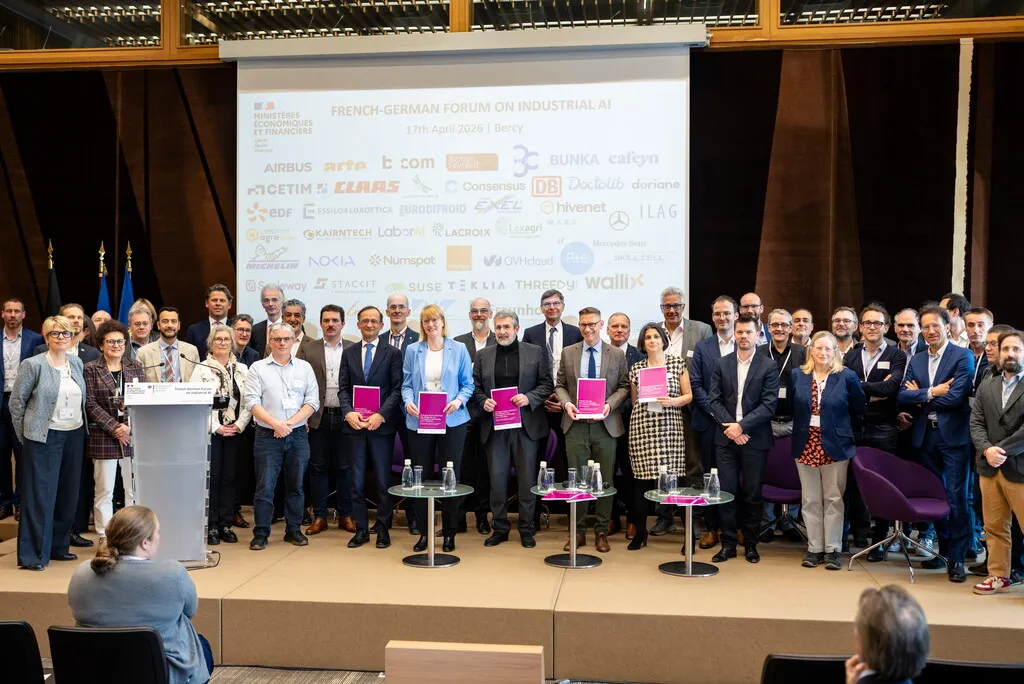
On the occasion of the Franco-German Forum on Industrial AI, held at the Ministry of the Economy and Finance, the report from the Franco-German Dialogue of Industry Leaders in Artificial Intelligence was officially presented to Thomas Courbe, Director-General for Enterprise, and Dr Beate Baron, Director-General for Industrial Policy at the German Federal Ministry for Economic Affairs and Energy. Supported by the French Embassy in Berlin and led by the Fraunhofer-Gesellschaft, Inria and the Institut Mines-Télécom (IMT), this report aims to propose concrete actions to build a sovereign, competitive and sustainable European AI ecosystem.
- Seven key sectors shaped by an unprecedented mobilisation of industry players.
- Concrete priorities and strategic industrial projects at European level.
- A Franco-German partnership working towards sovereign, competitive and responsible AI.
This handover marks the culmination of work that began in January 2025, when the Dialogue was launched in Berlin. Initiated by the French Embassy in Germany and jointly led by Inria, the Institut Mines-Télécom and the Fraunhofer-Gesellschaft, this initiative has brought together, within an open coalition framework, key players from industry, applied research and academia in both countries.
The report was presented by Bruno Sportisse, President and CEO of Inria, Boris Otto, Director of Fraunhofer ISST and Chair of the ICT Group Board of Directors, and Cécile Dubarry, Director General of the Institut Mines-Télécom. Through this joint presentation, the three institutions highlighted the complementary nature of their expertise, working towards a shared objective: to establish a sovereign, competitive and sustainable European AI ecosystem.
Furthermore, their combined expertise and capabilities in technological innovation, business models and governance for the integrated data and AI value chain effectively complement industrial contributions to the European ‘AI Continent’ strategy.
Shared priorities for a more autonomous European industrial AI sector
From its very outset, the Dialogue has helped to align the strategic priorities of the two countries. It has identified a common set of challenges, ranging from the simplification of the regulatory framework to the need to strengthen AI infrastructure and computing capacity in Europe, as well as issues relating to access to sustainable energy, attractiveness and talent development. This convergence is accompanied by a clear commitment to focus efforts on strategic industrial sectors and to promote artificial intelligence that is both effective and responsible.
Seven areas of action for moving from findings to projects
With this in mind, over a hundred stakeholders from the business and scientific communities were brought together in dedicated sector-specific workshops. This work has identified concrete use cases and investment priorities in several key sectors, including manufacturing, energy, healthcare, agri-food, as well as media and telecommunications. The proposals put forward are based on a detailed understanding of industrial needs and reflect a resolutely operational approach.
An overview of the priorities for industrial AI in Europe
The report is structured around seven complementary areas of action, each of which provides a structured overview of the needs and the levers to be activated at European level, and sets out recommendations:
1. Digital and computing infrastructure
Develop robust European infrastructures (cloud, networks, computing capacity, data spaces) capable of supporting the large-scale deployment of AI solutions, whilst ensuring interoperability and energy efficiency.
2. Sovereignty and regulatory framework
Clarify and adapt regulatory frameworks to reconcile innovation, competitiveness and sovereignty requirements, particularly in the implementation of European regulations on AI and data, or the extension of the cloud cybersecurity label to data spaces.
3. Health
Accelerate the adoption of AI in healthcare systems by facilitating access to data, data interoperability and the validation of solutions, in order to improve patient pathways and the efficiency of healthcare systems.
4. Manufacturing
Support the integration of AI into industrial processes, particularly in SMEs and mid-cap companies, to optimise production, strengthen resilience and enhance expertise, including through support mechanisms to reduce technical costs.
5. Media
Safeguard the sector’s information sovereignty and business models in the face of the rise of AI, whilst promoting content and data and regulating their use, particularly for training AI systems.
6. Energy
Harness AI to optimise energy systems, improve their resilience and support the transition to more sustainable and decarbonised models, for example through the implementation of dedicated large language models (LLMs).
7. Agri-food
Exploit the potential of AI to enhance the performance, traceability and sustainability of the agricultural and food sectors.
An approach based on practical needs to identify potential European projects
First presented at the Adopt AI summit in November 2025, these findings were consolidated in the report submitted to the French and German authorities on 17 April 2026. They provide a structured framework for guiding public policy, research programmes and industrial initiatives at European level. At the heart of this process, the approach adopted is based on feedback from the field, in which the needs of industry directly shape the roadmaps and future initiatives. This method is a key driver for bringing about concrete projects capable of strengthening European competitiveness in the field of artificial intelligence. The proposals set out in the report are intended to inform the PIIEC AI, by contributing to the definition and consolidation of strategic industrial projects at European level.