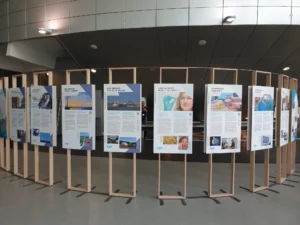
The Eiffel Tower is preparing to inscribe the names of 72 women scientists whose work has had a lasting impact on the history of science in France. This powerful initiative highlights careers that have long remained invisible and reminds us of the essential role women play in scientific progress.
Among these 72 exceptional figures, two of them are graduates of IMT Technological Universities, France’s leading public group of engineering and management. Their pioneering and inspiring careers resonate particularly with the IMT’s commitment to scientific excellence, diversity and the transmission of knowledge.
Rose Dieng-Kuntz, pioneer of artificial intelligence and the semantic web
Rose Dieng-Kuntz (1956-2008) was a computer scientist and a leading figure in artificial intelligence research. Born in Senegal into a modest family, in 1976 she became the first African woman to be admitted to the École Polytechnique. After graduating from Télécom Paris (class of 1980), she went on to earn a doctorate in computer science before specialising in what was then an emerging field: artificial intelligence.
After gaining initial experience at Digital Equipment Corporation, she joined INRIA in 1985. Rose Dieng-Kuntz recognised early on the potential of the web as a tool for disseminating and sharing knowledge. In the late 1990s, she was one of the pioneering researchers in the semantic web, a concept aimed at structuring and linking web data so that it could be understood and exploited by both machines and humans.
In 1999, when this new vision of the web was launched, she led her team to be among the first to develop intelligent models and algorithms for the extraction, formalisation and automatic processing of data. Her work made a lasting contribution to the evolution of information systems and digital uses.
An internationally recognised researcher, Rose Dieng-Kuntz was honoured with the Irène Joliot-Curie Prize in 2005. She died prematurely in 2008, leaving behind a major scientific legacy and a career that symbolised the opening up of science to all talents.
Anne-Marcelle Schrameck, the first woman to graduate as an engineer
Anne-Marcelle Schrameck (1896-1965) was a chemical engineer and a pioneering figure in French engineering. In 1917, she enrolled at Mines Saint-Étienne, becoming the first woman to be admitted to a prestigious engineering technological university. She graduated in 1919. The technological univerisity then closed its doors to women for more than fifty years, until 1970.
In 1920, Anne-Marcelle Schrameck was recruited by the Kuhlmann chemical factory in Lorraine. She performed demanding technical tasks there, descending 700 metres underground to supervise the work in an industrial environment that was then almost exclusively male.
She left the industry in 1922 after marrying Louis Kahn, a marine engineer, whom she accompanied on his successive postings to Brest, Saigon and then Lorient. After a particularly difficult period during the Second World War, she continued her career in the civil service, holding administrative positions in Algiers and then in Paris at the Ministry of Foreign Affairs.
Her career illustrates the structural obstacles faced by women engineers in the early 20th century, but also their ability to enter scientific and technical fields that had previously been inaccessible to them.
Recognition that echoes today’s women researchers
The inscription of the names of Rose Dieng-Kuntz and Anne-Marcelle Schrameck on the Eiffel Tower goes beyond individual recognition. It is part of a broader movement to highlight the scientific contributions of women and reminds us how excellence is built over time, through diversity of backgrounds and perspectives.
At IMT, this legacy resonates with the group and its Technological Universities‘ ongoing commitment to open and inclusive research excellence. Today, many female researchers are contributing through their work to advancing science and technology in key areas for major contemporary transitions.
Some are among the top 2% of most cited scientists in the world (Elsevier 2024 ranking), such as Isabelle Bloch at Télécom Paris, Catherine Tucker at Institut Mines-Télécom Business School and Maria Inês Ré at IMT Mines Albi.
Others have had their careers and work highlighted in I’MTech, the science and technology media outlet of the Institut Mines-Télécom, such as Valérie Forest at Mines Saint-Étienne, Cléa Martinez at IMT Mines Albi, Anne Bergeret at IMT Mines Alès, Maria Zuluaga at EURECOM and Elsa Dupraz at IMT Atlantique, winner of the “Prix Espoir IMT – Académie des sciences” 2024.
These contemporary trajectories continue the momentum initiated by the pioneers. They remind us that innovation stems from a wealth of perspectives, collective effort and knowledge transfer, and that IMT continues to support those who imagine and build the science and technology of tomorrow.