Supported by the Mines-Télécom Foundation, the IMT – French Academy of Sciences Prize honors outstanding scientific figures whose remarkable contributions have significantly advanced industrial and business-related challenges in support of a sustainable economy.
The 2025 edition reflects the IMT’s strategic priorities: health engineering, the industry of the future, and technological sovereignty.
- The Grand Prize is awarded to Stéphane Avril, Professor of Biomechanics at Mines Saint-Étienne and Director of the SAINBIOSE Laboratory at IMT, for his pioneering work in biomechanics, paving the way for personalized medicine.
- The Rising Talent Award goes to Damien Texier, CNRS researcher at the Clément Ader Institute (ICA) – IMT Mines Albi, for his research into the durability of critical materials under extreme conditions.
Their research—bridging fundamental science and industrial application—embodies IMT’s commitment to innovation in support of major transformations.
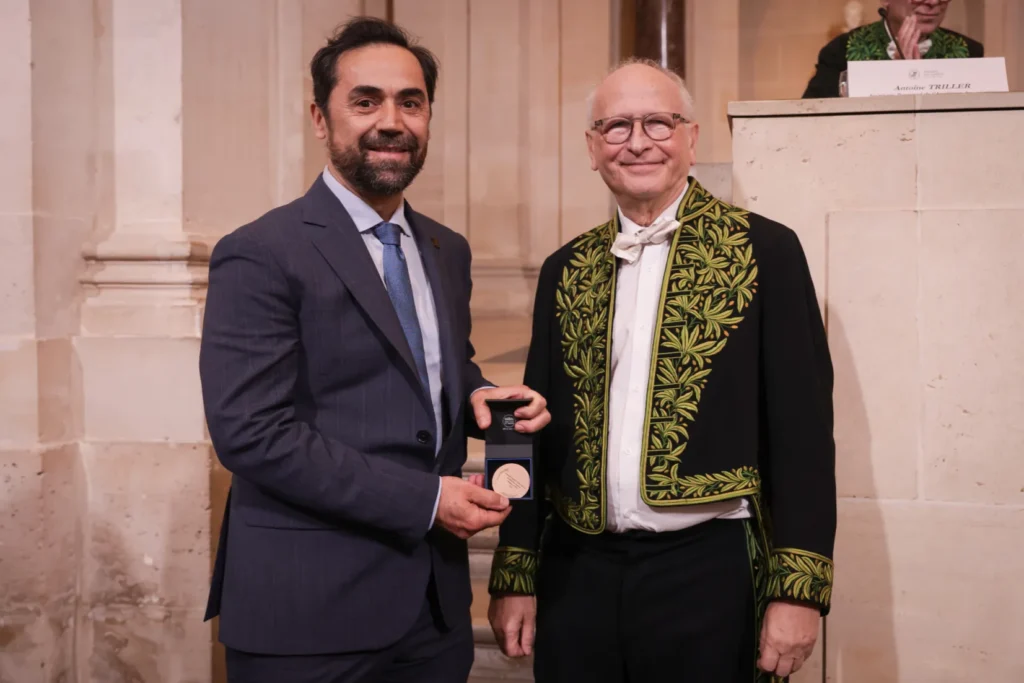
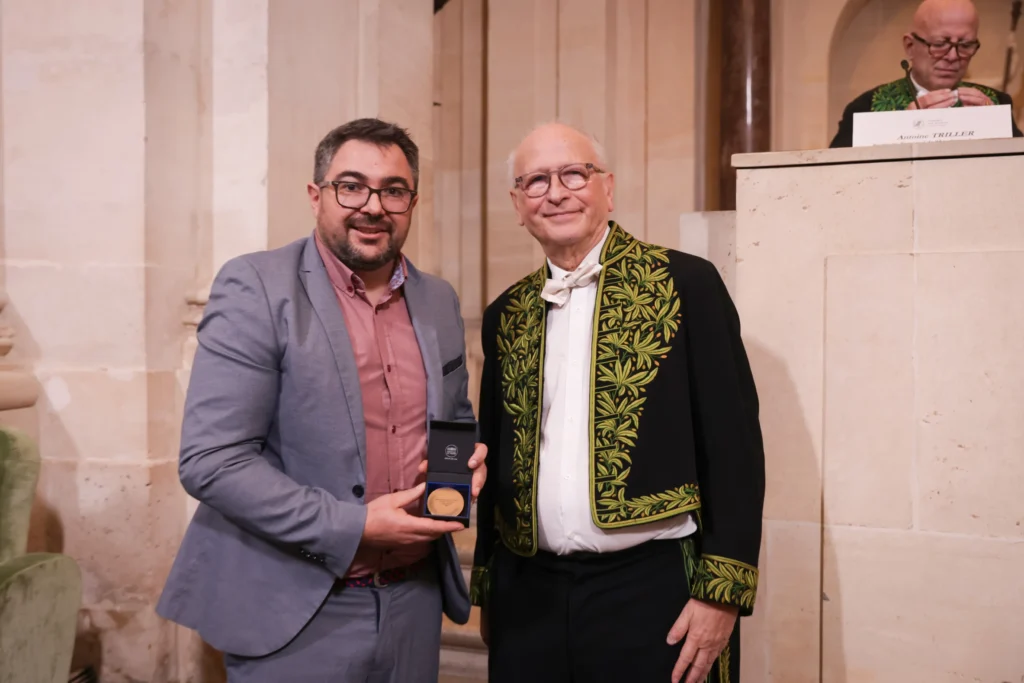
Grand Prize – Stéphane Avril
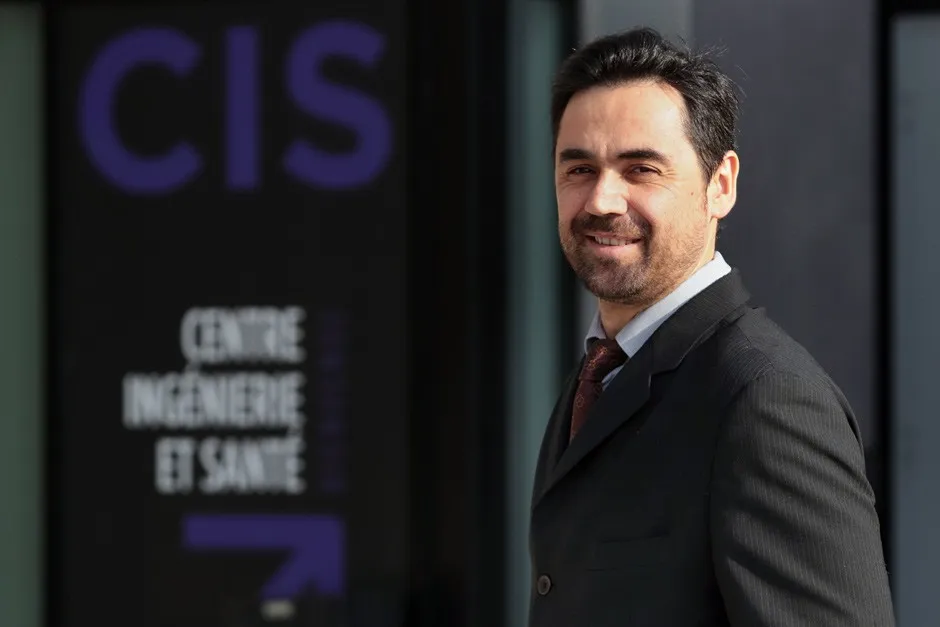
At the crossroads of engineering and life sciences, Stéphane Avril explores the emerging field of biomechanics. Widely recognized for his research and deeply convinced of the value of interdisciplinarity in biomedical innovation, his work has earned him the 2025 IMT – French Academy of Sciences Grand Prize.
One of the pioneers of medically applied biomechanics in France, Stéphane Avril began his career as a mechanical engineer and turned early toward studying biological tissues—investigating how the laws of mechanics apply to complex living structures such as the aorta. By combining numerical modeling, medical imaging, and experimental methods, he develops individualized digital twins capable of simulating the mechanical behavior of blood vessels under pathophysiological stress. These breakthroughs offer new possibilities for aneurysm rupture prediction and surgical planning.
After earning his PhD in 2002 from Mines Saint-Étienne, he joined the school in 2007 as a faculty member, following a research accreditation at the University of Technology of Compiègne. Today, he is the founding director of SAINBIOSE, a multidisciplinary Inserm lab operating at the interface of engineering, biology, and health.
His work—supported by three ERC grants (Consolidator, Proof of Concept, and Advanced), including the JuvenTwin project—focuses on understanding and slowing the mechanical aging of arteries. His commitment to knowledge transfer is also evident: he co-founded two start-ups, PrediSurge and KaomX, both derived from his research, demonstrating its tangible impact on medical technologies.
A mentor to more than 50 PhD candidates and 25 postdoctoral researchers, he continues to be a driving force in advancing digital twins in medicine and promoting biomechanics internationally at the intersection of engineering, biology, and clinical practice.
“I respectfully thank the French Academy of Sciences and the Institut Mines-Télécom for this honor, which recognizes a body of work. I also extend my deep gratitude to Mines Saint-Étienne, an IMT Technological University, for giving me the freedom and support to pursue long-term scientific research, including the creation of the start-ups PrediSurge and KaomX.”
— Stéphane Avril, 2025 IMT – French Academy of Sciences Grand Prize Laureate
Rising Talent Prize – Damien Texier
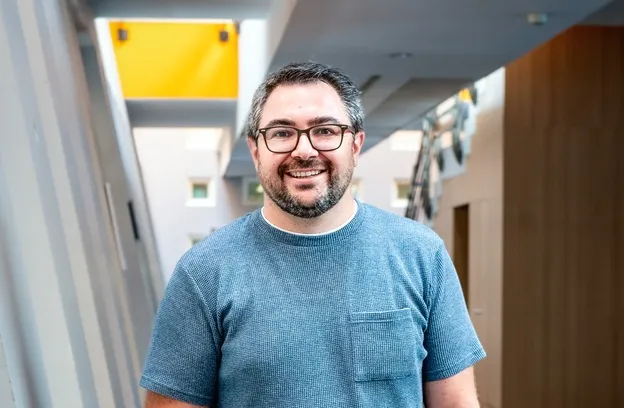
Focusing on the mechanical and chemical properties of materials at very small scales, Damien Texier studies the durability of critical metallic materials used in nuclear, aerospace, and transportation sectors. For his contribution to understanding the interactions between mechanics, environment, and material durability, he receives the 2025 IMT – French Academy of Sciences Rising Talent Prize.
A CNRS researcher at the Clément Ader Institute (IMT Mines Albi), he develops experimental methods in materials micromechanics. His research investigates how metallic materials evolve in extreme environments—such as turbines, nuclear reactors, and aircraft structures—under the combined effects of mechanical stress, oxidation, and chemical gradients. Using ultrathin sample preparation and correlative analysis techniques (mechanical, chemical, crystallographic), he isolates and quantifies localized phenomena previously difficult to access.
Following an engineering degree from Toulouse INP-ENSIACET and a PhD at CIRIMAT (2013), Texier pursued postdoctoral research at the Pprime Institute (Poitiers), the University of California at Santa Barbara, and ETS Montreal, before joining CNRS in 2017.
Today, he leads an integrated approach in correlative mechanical microscopy, combining nanoindentation, mechanical property mapping, and fine chemical characterization to better predict the durability of structural materials. With support from an ERC Starting Grant, he investigates hot oxidation effects in multilayer materials, contributing to the development of next-generation alloys for aerospace and energy.
“I am deeply grateful to the French Academy of Sciences and the Institut Mines-Télécom for awarding me this prestigious prize. It highlights my research in micromechanics and correlative mechanical microscopy to study the durability of aerospace and energy components.”
— Damien Texier, 2025 IMT – French Academy of Sciences Rising Talent Prize Laureate